
News
Discover the latest progress in cancer research, education and clinical care delivered by the MPCCC.

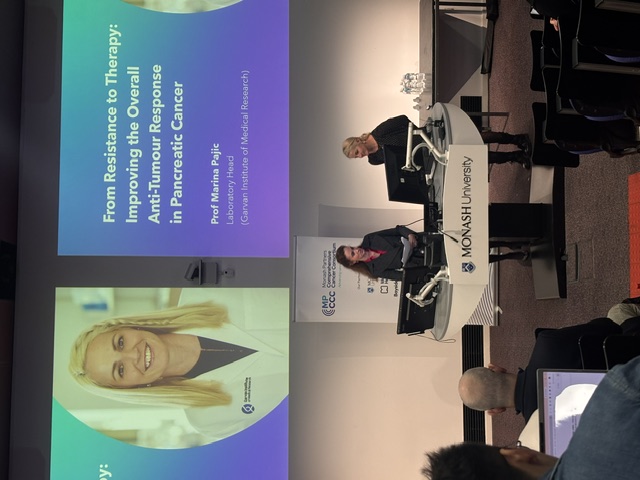
MPCCC Research Symposium explores advances in upper GI cancer care
Researchers, clinicians and health professionals came together for the inaugural MPCCC Research Symposium, focused on upper gastrointestinal (GI) cancer and the translation of research into clinical care across Victoria.
Held on 2 October 2026 and chaired by A/Prof Marion Harris of Monash Health, the symposium brought together perspectives from laboratory research, surgery, oncology, gastroenterology and nursing. The program focused on pancreatic cancer, from emerging treatment approaches and genomic testing to communication and education for patients and carers.
A/Prof Marion Harris explained, “Pancreatic cancer presents an urgent challenge. Bringing researchers and clinicians together helps us connect emerging discoveries with the decisions being made in patient care.”
The focus reflects the significant impact of pancreatic cancer in Australia. According to PanKind, 13.5% of people diagnosed in 2017–2021 survived at least five years, while 34% survived one year after diagnosis. PanKind estimates that 4,039 people may have died from pancreatic cancer in 2025 and reports that it was Australia’s third leading cause of cancer death in 2024. A 2025 survey also found that one in four Australians knew someone impacted by the disease.
Prof Marina Pajic of the Garvan Institute of Medical Research discussed research aimed at overcoming treatment resistance and improving the overall anti-tumour response in pancreatic cancer. Dr Daniel Croagh from Monash Health examined what circulating tumour DNA (ctDNA) may mean for pancreatic cancer care.
Dr Belinda Lee (WEHI) presented the PURPLE Translational Platform that supports data sharing and collaboration across laboratories and cancer treatment centres to advance novel therapies. Dr Owen McKay discussed comprehensive genomic profiling using endoscopic samples, including the EU ME PC 1 and EU ME PC 2 studies. Sue Bartlett, a medical oncology nurse practitioner at Bayside Alfred Health, highlighted the nursing role in multidisciplinary communication and patient and carer education.
Together, the presentations showed the breadth of work needed to move discoveries towards better care: developing new therapies, understanding how to use molecular information, and supporting people through complex treatment decisions.
MPCCC Program Manager Mrs Lama Karroum said; “The symposium showed how progress depends on many kinds of expertise, from developing new therapies and interpreting genomic information to helping patients and carers navigate treatment.”
The symposium was the first in MPCCC’s Research Symposium Series, which brings different cancer disciplines together to share research and strengthen connections across Victoria.
A new Precision Oncology Seminar series begins
MPCCC has also held the first event in its new Precision Oncology Seminar series, focused on an ovarian cancer organoid biobank. Chaired by A/Prof Simon Chu, the seminar featured Prof Gary Richardson OAM and Dr Sylvia Mahara from Cabrini Research, who introduced the ovarian biobank comprising tumour tissue, blood samples and patient-derived organoids linked with clinical data. They discussed the clinical challenges, what patient-derived organoids are, and how researchers can access the resource and explore opportunities for collaboration.
The ovarian cancer biobank is one of five projects supported through MPCCC’s Cancer Research Resource Grant, which awarded $300,000 in 2024 to develop resources for discovery, translational and clinical cancer research. As the grant concludes, the seminar series will showcase the funded projects and help researchers understand how they can use these resources in their own work.
Watch the recording of the seminar.


